

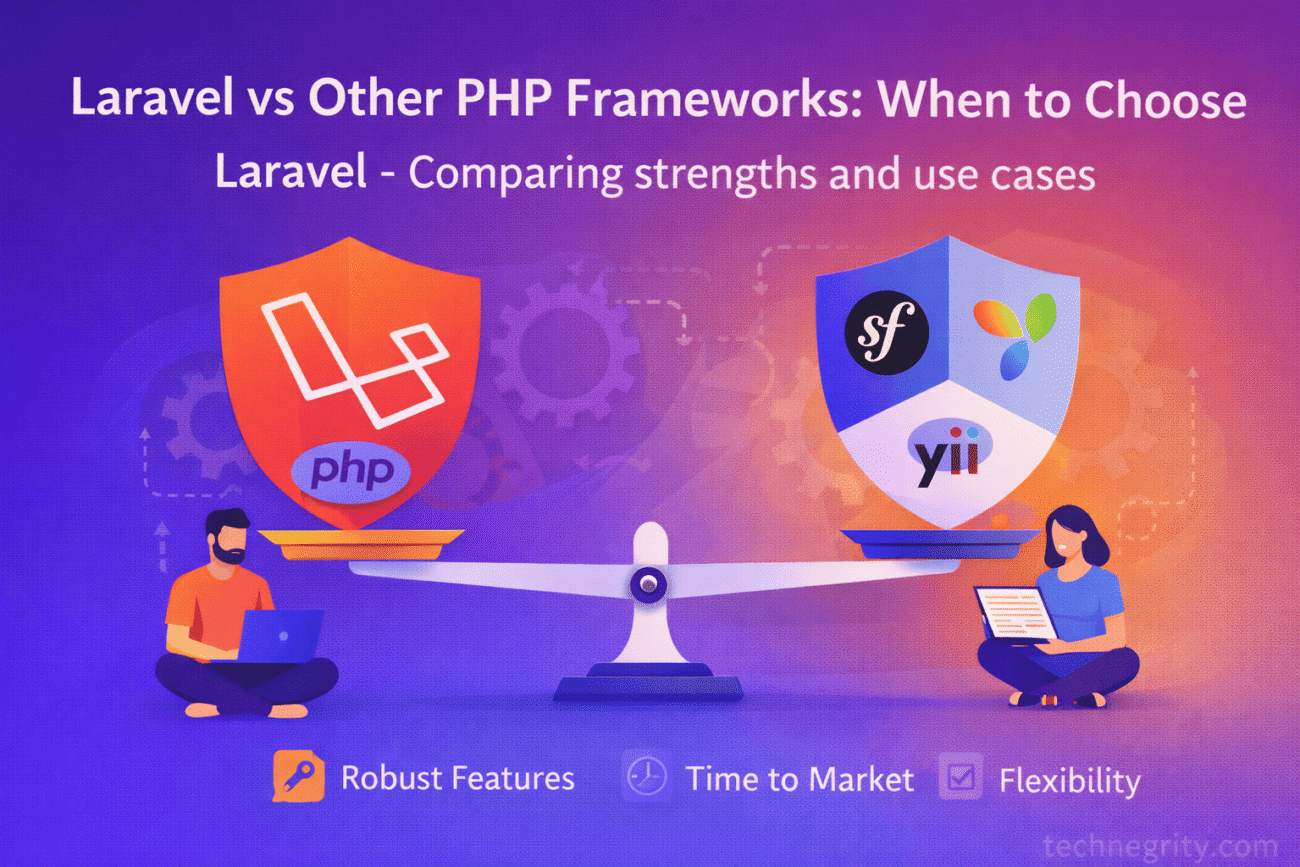
Choosing the right PHP framework can make or break your project. While Laravel has emerged as one of the most popular PHP frameworks in recent years, it’s not always the best choice for every situation. In this comprehensive guide, we’ll compare Laravel with other major PHP frameworks and help you understand when Laravel is the right tool for the job.
Understanding Laravel’s Position in the PHP Ecosystem
Laravel, created by Taylor Otwell in 2011, has grown to become the most starred PHP framework on GitHub. Its elegant syntax, comprehensive documentation, and rich ecosystem have made it a favorite among developers. However, to make an informed decision, we need to understand how it compares to its competitors.
Laravel vs Symfony: The Battle of the Titans
Symfony is often considered Laravel’s most significant competitor, though the relationship is more symbiotic than adversarial; Laravel actually uses many Symfony components under the hood.
Symfony’s Strengths
Symfony excels in enterprise environments where flexibility and long-term support are critical. It offers a more modular approach, allowing developers to use only the components they need. Symfony is backed by SensioLabs and provides extended support for up to three years on LTS versions, making it ideal for large-scale applications that need stability guarantees.
The framework gives developers more control over the application architecture, which appeals to teams that want to build highly customized solutions without framework opinions getting in the way.
When to Choose Laravel Over Symfony
Laravel shines when development speed and developer experience are priorities. Its “convention over configuration” philosophy means you can build functional applications faster with less boilerplate code. The integrated Eloquent ORM is more intuitive than Doctrine (Symfony’s default ORM), making database operations smoother for most use cases.
Laravel’s ecosystem is also more cohesive. While Symfony offers flexibility, Laravel provides an opinionated, batteries-included approach with tools like Laravel Forge for deployment, Laravel Vapor for serverless applications, and Laravel Nova for admin panels. This integrated ecosystem can dramatically reduce the time spent on DevOps and infrastructure decisions.
Choose Laravel when you’re building web applications, SaaS products, or MVPs where time-to-market matters. Choose Symfony when you’re building complex enterprise applications that require maximum flexibility and long-term support guarantees.
Laravel vs CodeIgniter: Modern vs Minimalist
CodeIgniter represents the minimalist approach to PHP frameworks. It’s lightweight, has a small footprint, and is incredibly easy to learn.
CodeIgniter’s Strengths
CodeIgniter’s simplicity is its superpower. With minimal configuration and a gentle learning curve, it’s perfect for developers new to frameworks or for simple applications where you don’t need extensive features. The framework has excellent performance out of the box due to its lightweight nature, and it doesn’t enforce strict coding rules, giving developers freedom to structure applications as they see fit.
When to Choose Laravel Over CodeIgniter
Laravel is the better choice for modern web applications that require features like real-time broadcasting, job queuing, API authentication, or complex business logic. Laravel’s Blade templating engine is more powerful than CodeIgniter’s view system, and its migration system makes database version control seamless.
The active development and community support for Laravel far exceed CodeIgniter. While CodeIgniter 4 has brought improvements, Laravel’s ecosystem continues to evolve rapidly with new features, packages, and tools.
Choose Laravel for medium to large applications, API-driven architectures, or projects that will scale over time. Choose CodeIgniter for simple websites, legacy system maintenance, or when you need maximum performance with minimal overhead.
Laravel vs Yii: Performance Meets Elegance
Yii (particularly Yii2) is known for its performance and security features. It uses lazy loading extensively and is optimized for high-traffic applications.
Yii’s Strengths
Yii often outperforms Laravel in benchmark tests due to its efficient caching mechanisms and optimized code execution. It has robust security features built-in, including input validation, output filtering, and SQL injection prevention. Yii’s Gii code generator can rapidly create models, forms, and CRUD operations, which can speed up development for traditional database-driven applications.
When to Choose Laravel Over Yii
Laravel’s learning curve is gentler, and its documentation is more comprehensive and accessible. The Eloquent ORM is more intuitive than Yii’s Active Record implementation for most developers, especially those coming from other modern frameworks.
Laravel’s community is significantly larger, which means more packages, tutorials, and third-party resources. When you encounter a problem in Laravel, chances are someone has already solved it and shared the solution. Laravel also leads in modern PHP practices and features, with better support for event-driven architecture, real-time applications, and microservices.
Choose Laravel when team productivity and maintainability are priorities, or when you’re building applications with complex business logic. Choose Yii when raw performance is critical, such as for high-traffic applications where every millisecond counts.
Laravel vs Slim/Lumen: Full-Stack vs Micro
Slim is a micro-framework designed for building simple web applications and APIs. Lumen, interestingly, is Laravel’s own micro-framework sibling.
Micro-Framework Strengths
Micro-frameworks like Slim and Lumen are perfect for building lightweight APIs or microservices. They have minimal overhead, faster execution times, and give you complete control over which components to include. For RESTful APIs that don’t need full framework features, micro-frameworks can be ideal.
When to Choose Laravel Over Micro-Frameworks
Laravel is better when you’re building full-featured web applications that require authentication, authorization, email handling, file storage, and other common web application needs. While you can add these features to micro-frameworks, Laravel provides them out of the box with consistent APIs.
For teams, Laravel’s opinionated structure provides consistency across projects. Every Laravel developer knows where to find routes, controllers, and models, which reduces onboarding time and improves code maintainability.
Choose Laravel for complete web applications, admin panels, or projects that will likely grow in complexity. Choose micro-frameworks for simple APIs, serverless functions, or when you need absolute minimal overhead.
Laravel vs CakePHP: Rapid Development Showdown
CakePHP is another mature framework known for rapid development capabilities, following convention over configuration principles similar to Laravel.
CakePHP’s Strengths
CakePHP’s scaffolding capabilities are excellent for quickly generating CRUD operations. It has been around since 2005, making it stable and battle-tested. The framework requires zero configuration in many cases; you can start building immediately after installation.
When to Choose Laravel Over CakePHP
Laravel’s modern approach to PHP development, including better dependency injection, more elegant syntax, and superior testing capabilities, makes it more attractive for contemporary projects. Laravel’s ecosystem of packages through Composer is more extensive, and the framework’s approach to modern concepts like queues, events, and real-time broadcasting is more sophisticated.
Laravel also has better tooling, from Laravel Mix for asset compilation to Laravel Telescope for debugging and Laravel Horizon for queue monitoring. The developer experience in Laravel is simply more polished.
Choose Laravel for new projects where you want modern PHP practices and a thriving ecosystem. Choose CakePHP if you’re maintaining existing CakePHP applications or need extremely rapid CRUD development with minimal setup.
When Laravel is the Best Choice
After comparing Laravel with its competitors, certain scenarios clearly favor Laravel:
You’re building a modern web application: Laravel excels at full-featured web applications with authentication, authorization, email, file uploads, and real-time features. The framework provides all these out of the box with clean, maintainable code.
Development speed matters: Laravel’s elegant syntax, comprehensive documentation, and vast package ecosystem mean you can build features faster. The framework handles common tasks so you can focus on business logic.
You want a strong community and ecosystem: Laravel has the largest and most active PHP framework community. This translates to more packages, better documentation, more tutorials, and easier problem-solving.
You need modern features: Real-time broadcasting with Laravel Echo, job queues with Horizon, API authentication with Sanctum or Passport, Laravel stays at the forefront of modern web development needs.
Team consistency matters: Laravel’s opinionated structure means every Laravel project follows similar patterns. This makes onboarding new developers easier and improves code maintainability.
You’re building a SaaS application: Laravel’s built-in support for multi-tenancy (with packages), subscription billing (Laravel Cashier), and scalability features make it excellent for SaaS products.
When to Consider Alternatives
Laravel isn’t always the answer. Consider alternatives when:
- You need absolute maximum performance for high-traffic applications (consider Yii or optimize with Swoole).
- You’re building simple, lightweight APIs (micro-frameworks might be better)
- You need maximum flexibility for complex enterprise architecture (Symfony might be preferable)
- You’re working with strict legacy requirements (stick with what’s already working)
- Your team has deep expertise in another framework (switching costs might outweigh benefits)
Making Your Decision
Choosing a framework shouldn’t be based on popularity alone. Consider these factors:
Project requirements: What features do you need now and in the future? Laravel’s comprehensive feature set can be overkill for simple projects but perfect for complex ones.
Team expertise: A team experienced in Symfony will be more productive in Symfony initially, though Laravel’s learning curve is gentle enough that switching is feasible.
Performance requirements: For most applications, Laravel’s performance is more than adequate. For extreme high-traffic scenarios, consider performance-optimized frameworks or enhancement solutions like Laravel Octane.
Long-term maintenance: Laravel’s active development and large community mean better long-term support and easier maintenance.
Ecosystem needs: If you need ready-made solutions for payments, admin panels, deployment, or monitoring, Laravel’s ecosystem is unmatched.
Conclusion
Laravel has earned its position as the most popular PHP framework through excellent developer experience, comprehensive features, and a thriving ecosystem. It’s the best choice for most modern web applications, especially when development speed, maintainability, and feature richness are priorities.
However, the “best” framework is always the one that best fits your specific needs. Symfony offers more flexibility for complex enterprise needs, Yii provides better raw performance, micro-frameworks excel at lightweight APIs, and CodeIgniter remains viable for simple applications with minimal overhead.
The good news is that PHP’s framework ecosystem is mature and robust. Whether you choose Laravel or an alternative, you’re building on solid foundations. Laravel simply makes that foundation more accessible, more productive, and more enjoyable for most developers working on most projects.
Choose thoughtfully, build excellently, and remember, the framework is just a tool. Your problem-solving skills, code quality, and understanding of fundamental principles matter far more than which framework you choose.
